Covering our tour of Australias east-coast, north and outback in the year 4

Mittwoch, August 18, 2004

Rain and Showers in Sydney

We took the plane from Alice Springs to Sydney today, which brought us from one world into a completely different one - weatherwise, that is. We had the bluest sky in Alice Springs when we took off and landed in the rain and shower hell of winterly (as a matter of fact it IS winter over here) Sydney. Though temperatures did not differ too much, as both cities are at around 20 degrees celsius (and it was damn cold in Alice in the evenings..down to 1 or 2 degrees celsius).

The flight was surprisingly rough and a bit strange, by the way. We flew with Qantas for the first time, which means that we even got lunch onboard (yuck!, you call THAT lunch, Qantas?) and generally had a better service in contrast to Virgin-Blue flights. (Virgin-Blue is the australian counterpart to RyanAir) There even were neat LCD Displays, that miraculously descended from the ceiling shortly after take-off, allowing us to watch a harmless but nice Hollywood movie called "Connie & Carla" about two women pretending to be men that pretend to be women (got that, everyone? :). After that, I curiously switched through the audio-channels and stayed with one for a short while. After some minutes I listened more closely to the text of the song that had just begun and was a bit astonished to hear the singer sing these words: (imagine yourself looking out of a plane window at the rain, cloud and storm that covered Sydney almost totally at that time)

Sky pilot, sky pilot, how high can you fly
you'll never never never reach the sky.
[...]
soon there'll be blood and many will die
mother and fathers back home they will cry.
[...]


I thought to myself "wow , splendid choice for an onboard radio programme on a domestic flight" :) (I just learned that it is an anti-war song by "The Animals" from the late 60s)

Well, back to the interesting things: we spent the last seven days in the centre of Australia, after we reached Alice Springs with the Ghan (have a look at my last post for more info on that). We stayed in a fantastic backpacker hotel in Alice Springs for one night, picked up our campervan and started off to Uluru (also known as Ayers Rock). Surprisingly, our campervan was upgraded to the next bigger version free of charge, as the rental company was obviously short on the smaller models. It was also a very new model and looked like the deluxe version, so it was a very comfortable way of travelling for us.

Most people tend to think, that the town of Alice Springs is almost next to Uluru. This is almost true, if you consider 450km a "short distance". Its a pleasant drive however and the Outback around Alice was much different from the picture I had built up in my imagination. My imagination said, it should be red and flat. In fact, it was covered with absolutely green grass (spinifex, mostly) with yellow and blue-ish flowers in between. It was also much more rugged with lots of mountains, rocky ranges and several (also plant-covered) dunes. Maybe its just like this in winter, but it was a great sight, to say the least.

Our first sight of Uluru turned in fact out not to be Uluru, but Mount Conner, a strange looking mountain that rises abruptly into the sky before a huge plain. It is absolutely flat on top and I believe thousands of travellers have shouted "There, Uluru!!!" (pointing at Mt. Conner), while being on their way to Uluru.

[Intermission: its late in the evening and I will continue this post tomorrow!]

Have an awesome day!

Mittwoch, August 11, 2004

Back in Katherine

We are currently on our way to Alice Springs with the Ghan - one of the great old railways in Australia - and we have a three hour stop-over in Katherine. As we already saw the town of Katherine before and there was not much to do except for browsing the windows of shops, we decided to spent some time in an internet cafe again.
The Ghan, by the way, has not always been such a glorious railway. In fact, the final connection from Alice Springs to Darwin was just recently finished, about 100 years behind schedule (for one century it was only possible to travel from Adelaide to Alice Springs - half way of the total planned route). Additionally, the original Ghan was built partly onto a floodplain, so that the tracks were frequently washed away by the floods. Apparently this was not a good base for a regular train service, so the tracks had to be built elsewhere in the seventies again. In the years before, it was not uncommon that train passengers had to be supplied with food and water by parachute drops, as the train was often stranded virtually nowhere in the vast plains of the outback. And even if the tracks remained in place, the service was not too fast, as the Ghan once arrived ,10 days late in Alice Springs. The last of the old Ghan locomotives was finally put out of order in the late seventies, after it collided with a cow. ;)
Well, as far as Katherine, the tracks were in place and we did not hit any cows or other animals, but the pace of the train is a bit slow, as it travels at an average speed of 80km/h. On the other hand it is LONG. It consists of 42 wagons, each about 30m long, which brings the total length to way over 1km. The first sight of it is really impressive.

Here is a picture of the Ghan from some internet source:


Dienstag, August 10, 2004

Barramundi bite

woohoo! - we finally reached Darwin after travelling for 12 days and 4200 km's through the australian Outback!! And it is damn hot and humid here, but as far as I heard it is not a bit better in Germany, so I won't complain too much. :) We have our "lazy day" today, which leaves me with some time for internet access to provide you with a few updates.


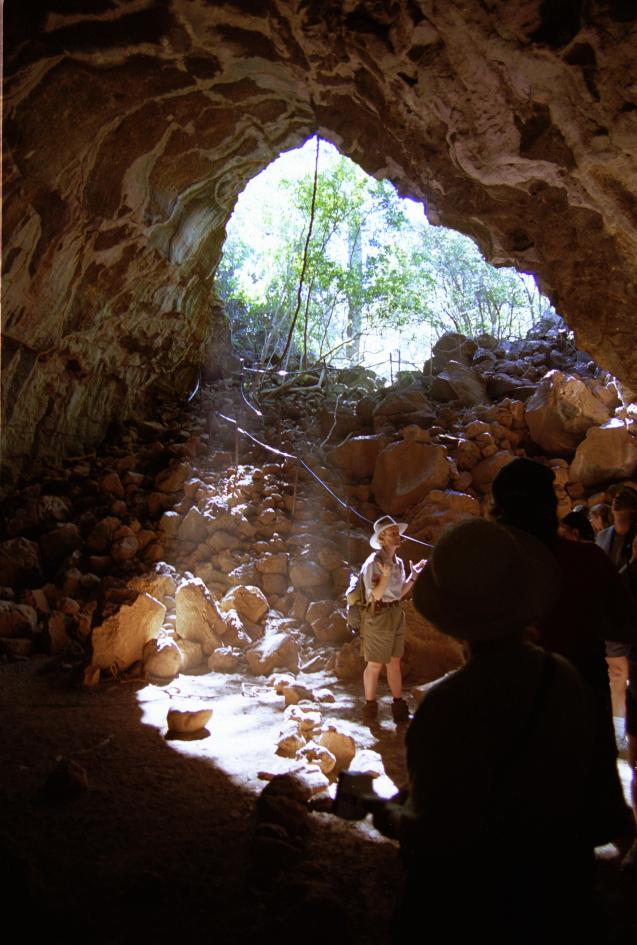
After we started our outback trip in Cairns twelve days ago, we first visited the Undara Lava Tubes - a giant system of underground tubes in the rock that were formed when the lava of a local volcano ran through several river-beds and other depressions about 190.000 years ago. The surface then cooled off, leaving behind the giant empty tubes - which originally extended for a total length of 160km over the country, making it the biggest system of its kind on earth. The tubes have collapsed at many places, but there are still long parts that you can walk through (the longest part that is still intact runs for 3km, though it is not open for public access). The tubes can in fact - due to the danger of collapses - only be visited by a guided tour. Neither I, nor the pictures can give you an impression of the size of the tubes or the feeling we had, when standing inside this 20 meter diameter tube, that was once filled by a stream of thousands degrees hot molten lava. At one part, the roof had come down into the tubes years ago and the tropical rainforest had found its way down into the underground, with huge fig trees extending their massive roots 20-30 metres deep into the tubes. The tubes were also populated by a few bats that hung down from the ceiling and eyed us closely as we shuffled past.


Undara Lava Tubes. Picture is not from us but from the internet.


Hm, I just realized that you will probably not know what a fig tree is. It is a bit hard to explain, as there are several types, and I am not sure whether I understood the whole concept completely myself. :) Fig trees start out as what you would call a "Liane" in german. Usually it grows from some point in a tree downward, getting bigger and bigger as time passes by (though some can also grow up from the ground into the treetops), turning from a small string into a huge wooden stem. One of the most famous fig trees - the strangler fig - is a somewhat destructive plant, as it grows around an already standing tree, finally killing it. It then can grow to an even bigger size than the tree it was originally a parasite on and sometimes grows into the the most weird shapes and forms.


This is the so called "curtain fig" near Cairns (picture is not from us but from some internet source). We did not stop at this tree, as we saw several very similar ones before.


After Undara, we continued through the outback to Karumba, a small town up at the Gulf of Carpentaria - actually the first place where we could watch the sun set above the ocean, as it usually sets above the countryside on the australian east-coast (unless mother earth decides to move the other way round for a change, at least). Karumba is the place to be, if you are into barramundi fishing. We were not, but we were absolutely satisfied with eating it, as it is the most delicious fish I have ever eaten in my whole life (!). After watching a few kangaroos, wallabies and exotic birds at a local billabong, we bought lots of Barramundi & Chips, drove our campervan up to the seaside and dined on the fish and chips as the sun set above the Gulf of Carpentaria. This was Ulrikes "dead animal day" by the way, as she spotted dead animals everywhere that had slipped my attention totally. The list included a snake (we were not sure if it was just the skin, or whether the snake had been overrun by cars thousands of times), a bat that had accidentally (and fatally) touched two overland electricity cables at once (part of it still hung from one the cables, as the rest had kind of exploded), several dead fish and the usual roadside kangaroos. Well, back to more pleasant topics: turtles! Living ones, that is! :) As we drove away from Karumba, Ulrike spotted a turtle on the other side of the road, that quickly vanished into its house, as we drove past. It must be said, that the road we drove on was the main highway connecting Karumba with the rest of the world and that it had more traffic than the usual remote outback road. While we stopped at the roadside, several Jeeps with trailers passed us on the other roadside, and by that time I was sure that we might have another sad casualty to add to our little list of death. Surprisingly, as we approached the turtles house it seemed absolutely intact and a few seconds later, the turtles head extended from the front of the house, curiously looking up at us. We heard another car approaching us and I grabbed the turtles house at both sides, bringing her to the safety of the grass at the side of the road. The car stopped and two friendly Australians asked us, whether we would be in need of any help (By the way: I believe in Germany I could have laid for hours bleeding in the grass next to the road with a huge sign in my hands saying "HELP! HELP! I AM DYING!" before anyone would have stopped). We explained the situation, laughed together for a while and discussed what an enormous luck this turtle had during its brave road crossing. The Australians drove away and I gave the turtle a final lift to a nearby billabong (a small lake), where I placed her right at the waters edge. During the whole process she curiously looked out of her house again. We waited a few minutes afterwards, to see if she really was not injured at all. She looked into our direction for a long time, drinking some water from the billabong, then extended her four legs and vanished happily into the waters. Mission accomplished ;)


Next stop on our tour was Lawn Hill National Park - a very remote national park that was as close to paradise as it can get, but sadly, this will have to wait until my next update, as Ulrike is pulling me out of the internet cafe at my left arm, with my right one typing these last words... (with the intent of making me write all these postcards to you, that I had no time to finish, yet) :)


PS: I found no WLAN accesspoints so far, so the uploading of pictures might still take some time (keep checking back!).

Donnerstag, August 05, 2004

News from Katherine

Just a very short update this time. We are in Katherine right now, a "bigger" town on our Outback route from Cairns to Darwin. From here we will continue our drive to the beautiful "Katherine Gorge" and then up to the "Kakadu National Park" - one of the most famous National Parks in Australia. Our route so far brought us from Cairns to the Undarra Lava Tubes (near Mt. Surprise), Georgetown, Karumba (at the Gulf of Carpentaria), Lawn Hill National Park (wonderful and very remote), Tennant Creek, the "Devils Marbles" (which was the deepest we got into the Outback so far), then back up to Daly Waters, where we spent the last night, and up to Katherine today. Everything went absolutely smooth up to now and our 4WD Campervan is just perfect for the route we have chosen. We had a few gravel-roads, some rougher tracks and even a few river-crossings, but the bigger highways are usually sealed, so you can travel at an comfortable speed of approximately 120km/h on these.
During the last days we saw crocodiles, saved a turtles life, went canoeing in the beautiful gorge of Lawn Hill National Park, ate the most perfect fish and chips (Barramundi) and saw lots and lots of impressive landscapes. More about all that from Darwin, where we will be in 3-4 days.